.png)
Myofunctional Therapy Atlanta: What It Treats and Who Benefits at High Hopes Therapy


Myofunctional therapy isn't a new treatment. The specialty has existed for decades. But it's gaining visibility in the Atlanta area as dentists, orthodontists, and pediatricians increasingly recognize the downstream effects of tongue posture, swallowing patterns, and oral breathing habits on dental development, sleep, and quality of life.
Myofunctional therapy in Atlanta at High Hopes Therapy addresses the orofacial muscle patterns that affect how the mouth, jaw, and airway function. For children and adults in the North Atlanta community, High Hopes' myofunctional therapy program treats the root causes of conditions that are often managed symptomatically by other providers without addressing the neuromuscular patterns underlying them.
What Is Myofunctional Therapy?
Orofacial myofunctional therapy (OMT) is a specialty within speech-language pathology that focuses on the muscles of the face, mouth, tongue, and throat. These muscles determine how you breathe, how you swallow, where your tongue rests when your mouth is at rest, and how your facial structures develop over time.
When these muscle patterns are dysfunctional, the effects extend across multiple body systems:
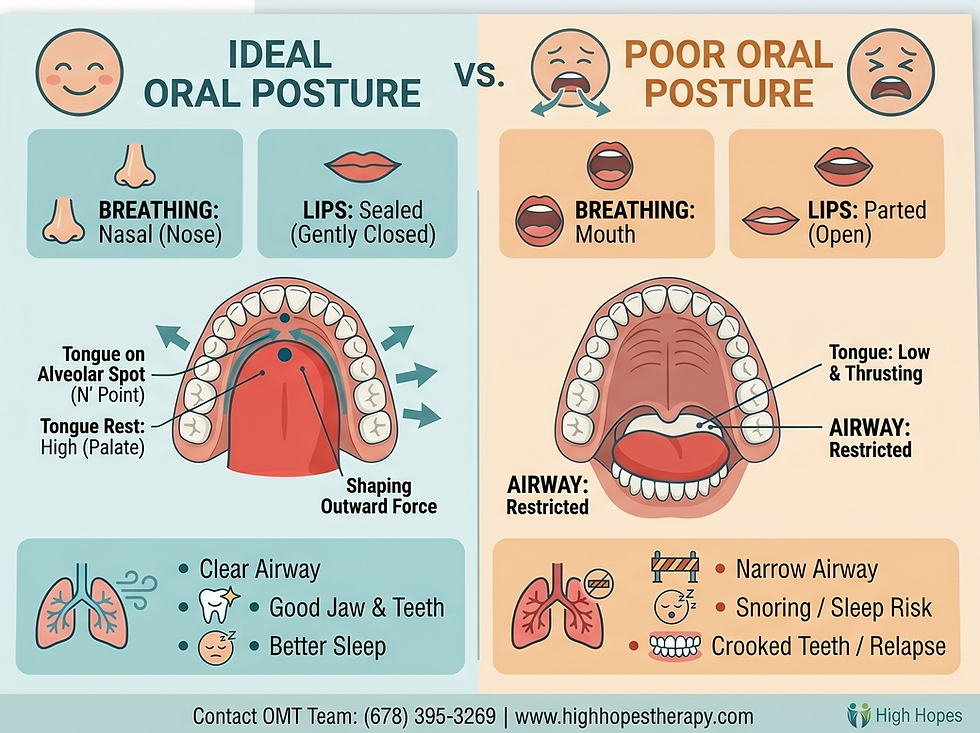
Dental development. The tongue's resting position inside the mouth exerts constant low-level pressure on the upper arch and palate. When the tongue rests on the floor of the mouth instead of on the palate (low tongue resting posture), it fails to provide the outward pressure that shapes the upper arch during childhood development. The result is a narrower palate, more crowded dentition, and greater orthodontic treatment complexity.
Swallowing. Normal swallowing requires the tongue to press up against the hard palate behind the upper front teeth. Tongue thrust swallow, where the tongue pushes forward against or between the teeth during swallowing, generates constant force against the teeth thousands of times daily. Over years, this contributes to open bite malocclusion, front tooth protrusion, and resistance to orthodontic correction.
Breathing. The nose is designed to breathe. It filters, humidifies, and conditions air before it reaches the lungs. Habitual mouth breathing bypasses all of these functions, increasing upper respiratory infection risk, affecting oral health through chronic dry mouth, and in children, potentially affecting facial development. The nose and mouth are designed for specific jobs: most people don't achieve both simultaneously.
Sleep. Tongue posture and airway muscle tone affect the airway during sleep. Low tongue resting posture and weak airway muscles are associated with snoring and obstructive sleep apnea in both children and adults.
What OMT Treats at High Hopes Therapy
Tongue thrust swallow:
The most common referral for myofunctional therapy. High Hopes' OMT program teaches correct swallowing mechanics through a systematic series of exercises and awareness activities. Tongue thrust correction takes several months of consistent practice but produces lasting change in both dental outcomes and orthodontic treatment stability.
Low tongue resting posture:
Retraining the tongue to rest on the palate requires building both the strength and the habit that most patients with OMDs have never developed. High Hopes' exercises build the muscular foundation for correct resting posture and the awareness to maintain it throughout the day.
Mouth breathing habits:
For patients whose mouth breathing is habit rather than structural obstruction, OMT teaches nasal breathing patterns and addresses the soft tissue factors (lip seal, tongue position) that support nasal airway use. For patients with structural nasal obstruction (enlarged adenoids, deviated septum), High Hopes coordinates with ENT providers to address the structural component before habit retraining can be fully effective.
Post-tongue tie rehabilitation:
Frenectomy frees the tongue from structural restriction but doesn't automatically produce normal tongue function. High Hopes Therapy provides the post-frenectomy rehabilitation that develops strength, coordination, and correct resting posture in the newly mobile tongue.
Thumbsucking and pacifier habit elimination:
Prolonged oral habits maintain low tongue posture, contribute to open bite, and perpetuate the neuromuscular patterns OMT is designed to correct. High Hopes' habit elimination program is a core component of the myofunctional therapy offering for younger patients.

Who Should Consider Myofunctional Therapy in Atlanta?
Orthodontists and pediatric dentists refer patients to High Hopes when they identify:
- Tongue thrust swallow creating open bite or resistance to orthodontic closure
- Open bite present or developing
- Patient in orthodontic treatment with compliance issues related to muscle patterns
- Low tongue resting posture with narrow palate
- Habitual mouth breathing
Pediatricians refer when they notice:
- Chronic mouth breathing
- Snoring or observed sleep apnea in children
- Feeding or swallowing concerns in infants and toddlers
Parents seek evaluation when they observe:
- A child who always has their mouth open at rest
- Visible tongue thrust during swallowing
- Extended thumb or pacifier habits in a school-age child
- A persistent lisp or articulation error that hasn't responded to standard speech therapy
High Hopes Therapy serves families across the North Atlanta area for myofunctional therapy evaluations and treatment. If you or your child has any of these concerns, contact us to schedule an evaluation.
Frequently Asked Questions About Myofunctional Therapy in Atlanta
How long does myofunctional therapy take?
Most OMT programs run 3 to 6 months for straightforward presentations, with sessions typically once to twice weekly. Cases involving post-frenectomy rehabilitation or coordination with active orthodontic treatment may run longer. The timeline is heavily influenced by daily home exercise compliance. Patients who practice their exercises consistently progress significantly faster than those who don't.
Does myofunctional therapy hurt?
No. OMT exercises involve deliberate muscle movements, oral posture awareness, and gradually building strength in specific patterns. None of the exercises involve pain. Post-frenectomy stretching exercises in the days immediately following surgery involve discomfort at the surgical site, but this is brief and expected as normal post-operative sensation.

Expert Pediatric Myofunctional Therapy in North Atlanta
High Hopes Therapy is North Atlanta's pediatric therapy provider for myofunctional therapy, speech therapy, occupational therapy, and related services. For families in Alpharetta, Johns Creek, Cumming, Duluth, and surrounding communities, High Hopes provides the specialized expertise that myofunctional concerns require.
Myofunctional therapy is one of those specialties that produces visible, measurable changes in the way patients use their mouths, breathe, and develop. For children, it can mean better orthodontic outcomes, better sleep, and better breathing. For adults, it often means improvement in sleep quality and reduced dependence on nighttime breathing devices. For patients of any age following tongue tie release, it's the therapy that makes the surgical intervention actually work.
Transforming Breathing, Sleep, and Oral Health with Myofunctional Therapy
Schedule your myofunctional therapy evaluation, or Call us at (678) 395-3269 to learn more about our myofunctional therapy program and all of the pediatric therapy services available at High Hopes Therapy in North Atlanta.
Every child deserves the best start. High Hopes Therapy provides the expert care to help them get there. We look forward to supporting your family.


Comments